
Cactaur: A desert dwelling anthropomorphic cactus. People and cactaurs hunt one another for the same reason: their water. While they can shoot their needles at a foe as an attack, only the legendary, saguaro sized ones can use the nightmarish Thousand Needles attack.
Camel, Bactrian: long-endurance mounts used by the nomads of the eastern Plains of Kring. Lousy for draft work, merely poor tempered, and rarely found in more temperate regions. Identified by their double hump.
Camel, Dromedary: long-endurance mounts used by the Hazad Caliphate. Lousy for draft work, foul tempered, and rarely found in more temperate regions. Identified by their single hump.
Candleman: A humanoid creature of uncertain origins. A man-like figure covered in wax, armed with huge candle flames on the ends of its arms and atop its head. Not fast moving, but very agressive, candlemen attack with flame, and by smothering their victims with hot wax. Any humanoid slain by a candleman will rise as one themselves. Nocturnal, they appear to be the result of some ancient curse.
Catoblepas: An amphibious herbivore massing three quarters of a ton, preferring shallow wetlands, that resembles nothing so much as a cross between a brontosaurus and a cow. It is generally assumed that whoever created it, be they god or mortal, was mentally impaired at the time. Catoblepas are even tempered creatures, whose primary defense is their gaze attack, which can paralyze any creature it looks upon, no matter how strong their defenses against Mental or Body magics might be. Survivors have no recollection of the time spent so affected.
Centipede, Cinnabar: A giant yellow centipede found in the Altun Shan Mountains. Otherwise identical to Vermilion Centipedes.
Centipede, Vermilion: A giant arthropod found in the Northwall Mountains. These fierce carnivores have body segments a yard across, and are relentless hunters. Fortunately, they do not function well at night or in the winter, and lurk in their caves during those times. Extermination hunts are one of the few causes that bring the people of Yamato and the Dwarven Halls together.
Chimera, Crafted: The general term “chimera” refers to a creature made up of the body parts of multiple animals. Gryphons, Nues, and Lamias all technically fall in this category. Crafted chimerae have been assembled by mages or alchemists of, well, dubious ethics (and sanity, frequently). Imagination and perseverance are the only limitations to what can be stitched together into a one-of-a-kind rampaging abomination of destruction!
Chirra: Northern relatives of camels and llamas, frequently raised for their wool as well as their winter mobility. They are remarkably good natured: their early ancestors realized people made fires, and fire means not freezing. Do not do well in warmer climates.
Chocobo: Auroch-like flightless birds, but with heads large enough to put a few brain cells in. As versatile as horses, but too small for anything but light cavalry. Omnivorous if desperate: their preferred foods are root crops, gourds, and squashes, with an overwhelming passion for cucumbers. There are exotic, empowered breeds of chocobo, including:
- Blue: Blue chocobos possess the ability to run on water. There appears to be a direct correlation between how dark a hue they have, and the depth of water they can cross.
- Golden: Metallic hued chocobos with the capabilities of Blue, Green, and Red.
- Green: Green chocobos can run across the forest canopy, or any other vegetation without crushing it.
- Red: Red chocobos are able to traverse any difficult terrain, up to and including vertical cliffs.
- Silver: Metallic hued chocobos with the ability to physically travel to and from the Spirtitplane, and through it to the Other Realms.
Chocotrice: when a male chocobo is impregnated by a duner (please, stop intermixing your livestock in breeding season!), you get an untamable black chocobo whose gaze, if you meet it, will transform you into your weight in cucumbers. Other chocobos are immune, and routinely accept chocotrices as flock leaders.
Cobra-Duck: a chimerical waterfowl with the body of a large goose, and the neck and head of a cobra. Venomous, migratory, and mean. Yes, it's a canard with canards.
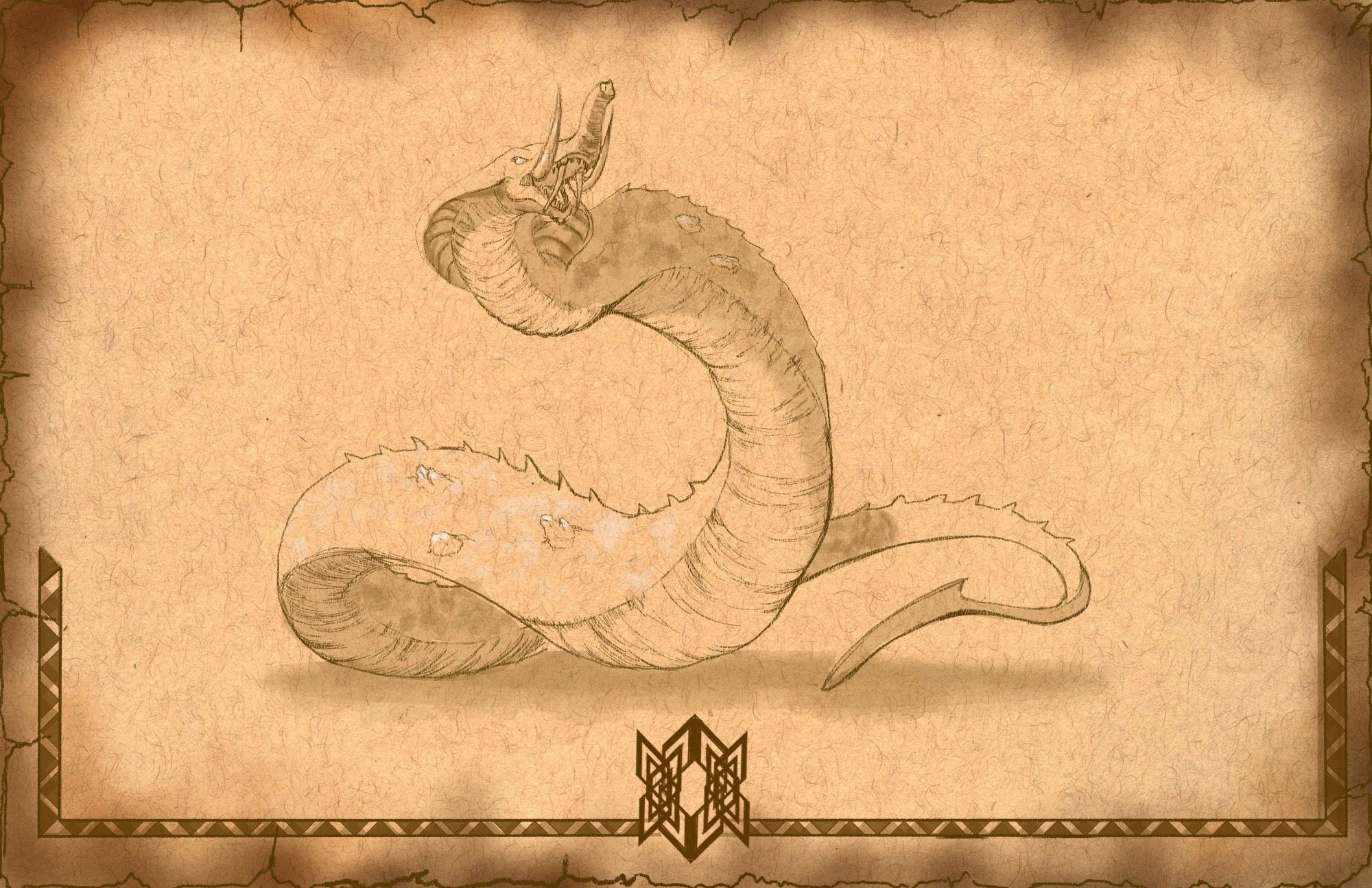
Cobraphant: a two-ton venomous serpent with the head of an elephant. One of the Jungle god's favorite creations: they decorate many of his temples, and he had a tendency to drop them on anyone who annoyed him. Sometimes several.
Cockatrice: similar genesis to a basilisk, though you probably need to start with poisonous toads or frogs. Resembles a diseased chicken the size of a wild turkey. Venomous, poisonous, waste products are toxic, shed feathers are toxic, and it is probably bad to breathe around one. No known reputable use.
Coerl: A feline predator the size of a tiger with the build and coloration of a leopard. Coerls have a pair of two meter long highly agile tendrils growing from their muzzles that they use to generate a ranged attack that straddles the line between fire and lightning. Coerls can be found in a wide range of environments, and hunt either singly or in mated pairs. Do not breed in captivity, but are considered the top pet for highborn ladies in all six empires.
Cognate: A predatory creature native to the wetter areas of the underdark and dismal swampland. Visually, a cross between a brain and a trilobite. Functionally, a Cognate operates as a cross between an AD&D Intellect Devourer and a Face Hugger. Cognates use native Mind magic to stun their prey, then launch themselves at its head to inject the biological material that transforms the victim’s brain into another Cognate. The power and intelligence of the creature depends upon the intellect of the original host. Cognates born from Dark Elves are frequently sentient.
Colibri: A pinkish avian resembling a toucan, native to the Asterian Empire and Uruk Mandarinate. In late spring, they will migrate north as far as the Yamato Shogunate and the Anyube river basin to mate, lay eggs, and raise chicks. Colibri do not domesticate, and there are three important factors one should know if one wishes to hunt them. First, their distress cry can be heard for quite some distance, and will attract any colibri in the vicinity. Second, they can wreathe their beaks in Vibrational Blade, which tears through armor quite handily. And third, they can mimic any spell or similar ability used in their presence at a similar power level to the original caster.
Cows: raised for milk, meat, and their hides.
Coyote: Fundamentally half sized wolves that operate more often as solo hunters. Native to the eastern plains regions of the northern continent.
Crab, Hitagi: Native to the shores of the Yamato Empire, Rikkor, and the abandoned territories between, these crustaceans are roughly the size of an ox. Like far too many Yamato region monsters, they are incredibly stealthy, and if they do not kill you, their wounds leave a curse that reduces your body weight by 90%. Technically the beast has stolen your weight, and it is possible to get it back, but it isn't easy. On top of being a person-sized kite, the curse also makes it much more difficult to retain one's body heat.
Creeping Coins: NOT BUGS! In the early Divine Era several civilizations developed the practice of putting low level magical inscriptions on pretty much every durable artifact they made: bricks, utensils, floor tiles, paving stones…
…money. What they didn't comprehend was how to deal with the chaotic effects of overlapping unregulated magical fields, eventually leading to their cataclysmic extinction.
Creeping Coins are a mass of change, usually 200+, inscribed with “do not deface” and “keep in pocket”. this makes them difficult to fight, and possessed of an urge to jam themselves in any opening they can get at on every humanoid they encounter.
Cuin Annun: Resembling black furred jackals with baleful green flaming eyes, these pack scavengers can be found throughout the northern independent territories. They are naturally Evil creatures, and inherently infused with elemental Necromantic energies. Anything that dies from their bite rises again the following night as a zombie, and goes looking for the pack. Cuin Annun can turn off the eye glow to sneak up on prey, and refuse to enter or remain within buildings. They are affected by sunlight in much the same way as common trolls, and spend daylight hours in their dens.